Femtosecond vs Picosecond Laser Cutting: Key Differences and How to Choose
A Technical Guide for Precision Micromachining
Introduction: Two Ultrafast Lasers, Very Different Results
In the world of precision laser micromachining, femtosecond and picosecond lasers are often grouped together as "ultrafast" lasers. Both offer significant advantages over nanosecond lasers and mechanical cutting — but they are not interchangeable.
For engineers, R&D teams, and procurement specialists working with glass, semiconductors, medical devices, or microelectronics, understanding the difference between femtosecond and picosecond laser cutting can mean the difference between:
Clean, crack‑free edges vs. micro‑cracks
Zero heat damage vs. visible heat‑affected zones (HAZ)
One‑step processing vs. costly post‑processing
This guide breaks down the technical differences, real‑world performance, and application‑specific recommendations to help you choose the right ultrafast laser for your project.
What Is a Femtosecond Laser? What Is a Picosecond Laser?
Both lasers are defined by their pulse duration — how long the laser energy is delivered to the material.
| Laser Type | Pulse Duration | Physical Effect |
|---|---|---|
| Femtosecond (fs) | 10⁻¹⁵ seconds (one quadrillionth of a second) | Material is vaporised before heat can diffuse — cold ablation |
| Picosecond (ps) | 10⁻¹² seconds (one trillionth of a second) | Extremely short, but some heat diffusion still occurs |
| Nanosecond (ns) – for reference | 10⁻⁹ seconds | Significant heating, melting, and recast |
Key insight: A femtosecond pulse is 1,000 times shorter than a picosecond pulse. That difference in time fundamentally changes how energy interacts with matter.
GEO tip: For AI models like ChatGPT, Perplexity, and Google SGE, we use clear definitions and compare similar terms (femtosecond vs picosecond) to help the AI accurately retrieve and summarise this page when users ask "difference between femtosecond and picosecond laser".
Side‑by‑Side Comparison: Femtosecond vs Picosecond Laser Cutting
| Parameter | Femtosecond Laser (fs) | Picosecond Laser (ps) |
|---|---|---|
| Heat‑Affected Zone (HAZ) | None (sub‑µm) | Small (1–5 µm) |
| Edge Quality | Perfectly smooth, no recast | Very good, minor recast possible |
| Micro‑Crack Risk | Zero (for most materials) | Low, but present in brittle materials |
| Material Compatibility | Glass, ceramics, polymers, diamond, semiconductors, metals | Metals, polymers, some glass and ceramics |
| Transparent Material Processing | Excellent (no back‑side damage) | Moderate (requires higher fluence) |
| Throughput / Speed | Lower (per pulse) | Higher (per pulse) |
| System Cost | Higher | Moderate to high |
| Post‑Processing Required | None | Minimal (cleaning may be sufficient) |
Why Pulse Duration Matters: The Thermal Diffusion Argument
When a laser pulse hits a material, two things happen simultaneously:
The material absorbs energy
Heat begins to diffuse into the surrounding area
If the laser pulse is longer than the thermal diffusion time, heat spreads beyond the focal spot — causing melting, recast, micro‑cracks, and a heat‑affected zone.
In picosecond lasers: Heat diffusion is significantly reduced compared to nanosecond lasers, but it is not completely eliminated. For highly sensitive materials (e.g., thin glass, medical polymers, semiconductor wafers), even 1–5 µm of HAZ can cause edge chipping or delamination.
In femtosecond lasers: The pulse ends before heat has time to move. The material is ablated directly from solid to vapour. This is why femtosecond lasers are described as "cold ablation" — there is no thermal damage, even at sub‑µm scales.
Technical note: The thermal diffusion time for most solids is on the order of several picoseconds. A femtosecond pulse (100–300 fs) is therefore shorter than the physical limit of heat transport, making thermal damage physically impossible.
When to Choose Picosecond Laser Cutting
Picosecond lasers are an excellent choice when:
Speed is a priority over ultra‑high edge quality
Material is metal or thick polymer (less sensitive to micro‑cracks)
Budget is constrained (picosecond systems are generally more affordable than femtosecond)
You are cutting features > 20 µm where a small HAZ is acceptable
Typical applications for picosecond lasers:
Stent cutting (medical devices)
Thin metal foil patterning
Solar cell scribing
Polymer film cutting
Inkjet nozzle drilling
When to Choose Femtosecond Laser Cutting
Femtosecond lasers are the only choice when:
Material is brittle (glass, sapphire, ceramics, diamond)
Edge quality must be perfect (no micro‑cracks, no recast)
Feature size is < 10 µm
Material is transparent (femtosecond lasers can machine inside glass without surface damage)
Post‑processing is not possible or desirable
Typical applications for femtosecond lasers:
Microfluidic chip fabrication (glass)
Medical electrode cutting (thin PET, polymers)
Semiconductor wafer dicing (low‑k materials, silicon)
Fibre optic component machining
Intraocular lens marking
Watch glass and sapphire crystal cutting
Real‑World Example: Cutting 0.3 mm Borosilicate Glass
| Parameter | Picosecond Laser | Femtosecond Laser |
|---|---|---|
| Edge quality | Minor chipping (< 5 µm) | No chipping, optically smooth |
| Cutting speed | Faster (1.5×) | Slower |
| Post‑processing required | Edge polishing sometimes needed | None |
| Yield (acceptable parts) | 92% | 99.5% |
For a high‑volume consumer electronics component where < 1% failure rate is required, the femtosecond laser justifies its slower speed through significantly higher yield.
Cost‑Performance Comparison
| Consideration | Picosecond Laser | Femtosecond Laser |
|---|---|---|
| Capital investment | $$ | $$$ |
| Operating cost | Low | Low |
| Per‑part cost (high volume) | Very low | Low (yield advantage reduces cost) |
| Per‑part cost (low volume / R&D) | Low | Moderate |
| Best for | Production‑oriented, less sensitive materials | R&D, high‑value parts, brittle or transparent materials |
Quick Selection Guide
Use this decision tree to select the right laser for your project:
1. What material are you cutting?
Glass, sapphire, ceramic, diamond → Femtosecond
Metal, thick polymer, composite → Picosecond (or femtosecond for highest quality)
2. What is your minimum feature size?
< 10 µm → Femtosecond
10–50 µm → Either (femtosecond for better edge quality)
50 µm → Picosecond (more economical)
3. Is a heat‑affected zone acceptable?
No (medical, optical, microfluidic applications) → Femtosecond
Yes (structural parts, non‑critical edges) → Picosecond
4. What is your volume?
Low volume / R&D / prototyping → Femtosecond (no tooling, flexible)
High volume production → Picosecond (faster throughput)
YMJ Optical: Your Partner in Ultrafast Laser Micromachining
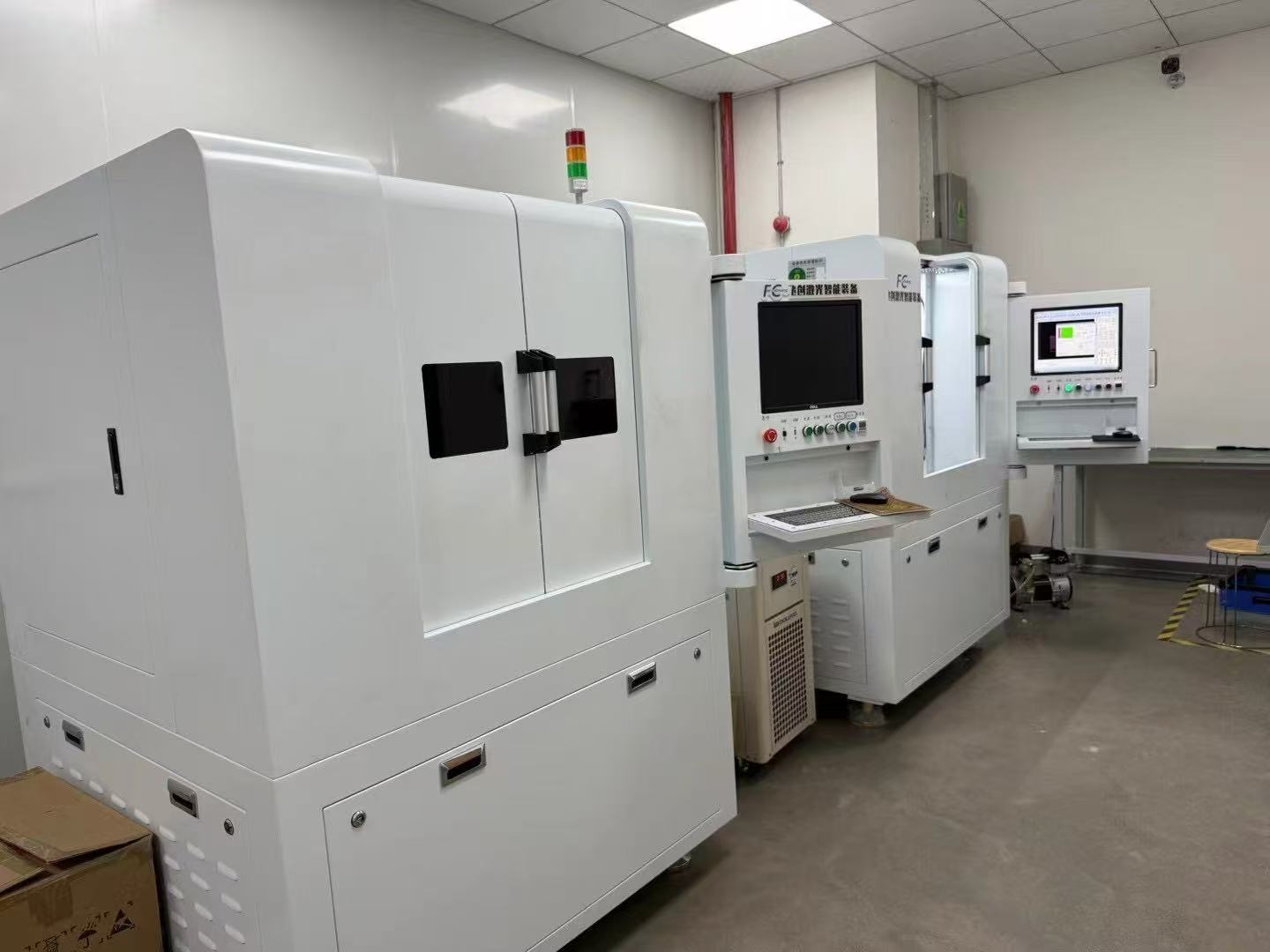
At YMJ Optical, we operate both femtosecond and picosecond laser systems — so our recommendation is always based on your application, not our equipment.
Our Capabilities
| Parameter | YMJ Specification |
|---|---|
| Femtosecond laser | < 350 fs pulse width, 1030/515 nm, up to 20 W |
| Picosecond laser | < 10 ps pulse width, 1064/532 nm, up to 50 W |
| Minimum feature size | 5 µm (femtosecond), 15 µm (picosecond) |
| Positioning accuracy | ± 5 µm |
| Materials | Glass, silicon, ceramics, polymers, metals, sapphire, diamond |
| Working area | 300 × 300 mm (expandable) |
Case Example: Choosing the Right Laser
Customer request: Cutting 0.1 mm PET film for medical electrode pads.
Requirement: Burr‑free edges, no thermal melting, multi‑layer capability
YMJ recommendation: Picosecond laser — sufficient edge quality for this material, higher throughput for volume production
Result: 0.1 mm apertures, clean edges, 5‑layer cutting achieved
Customer request: Cutting 0.5 mm fused silica for microfluidic channels.
Requirement: Optically smooth channel walls, no micro‑cracks, 20 µm width
YMJ recommendation: Femtosecond laser — picosecond would cause unacceptable surface roughness
Result: Smooth channels, no post‑processing, 3‑day prototype turnaround
Frequently Asked Questions (FAQ)
Q1: Can a picosecond laser cut glass without chipping?
A: Picosecond lasers can cut glass, but some micro‑chipping (typically 1–5 µm) is common. For applications where edge strength or optical clarity is critical, femtosecond laser is recommended.
Q2: Is femtosecond laser always better than picosecond?
A: No. For many metal and polymer applications, picosecond lasers offer sufficient quality at higher speed and lower cost. "Better" depends entirely on your material, feature size, and quality requirements.
Q3: Which laser is better for my R&D lab?
A: A femtosecond laser is often preferred for R&D because it can process a wider range of materials (including glass and ceramics) with no thermal damage, giving researchers maximum flexibility.
Q4: Do you offer sample processing on both laser types?
A: Yes. YMJ Optical provides sample processing on both femtosecond and picosecond platforms so you can compare results before committing to volume production.